

Most teams that I work with are adopting and integrating AI. Most individuals I interact with are producing more in less time instead of producing the same amount and exploring or slacking off. You see the progress, but I see one consistent difference between them and those at the peak.
“After 20 minutes the AI creates this PowerPoint that would have taken me 90 minutes to build.”
– Great, once your vision was in place for what you needed to create, why didn’t it take 5 minutes?
“I shipped this new feature in three hours! This would have taken three days in the old world?!”
– Great, why didn’t it take 10 minutes?
There is an answer to those questions. Something needs to change in your code, infrastructure, data, skills, tools, or some combination or even all of the above in order to enable AI to accomplish your vision faster and better than before.
Every time you work, you and the AI are generating data and results together. Bad paths are pursued and pruned. New paths are discovered. After painstakingly working your way through a problem for minutes, hours, or even days, are you really throwing away all those hard-fought lessons into the garbage with a simple “clear” command or exit button?!!
WHAT ARE YOU DOING??!!
I am reminded of my favorite World War 2 propaganda poster.
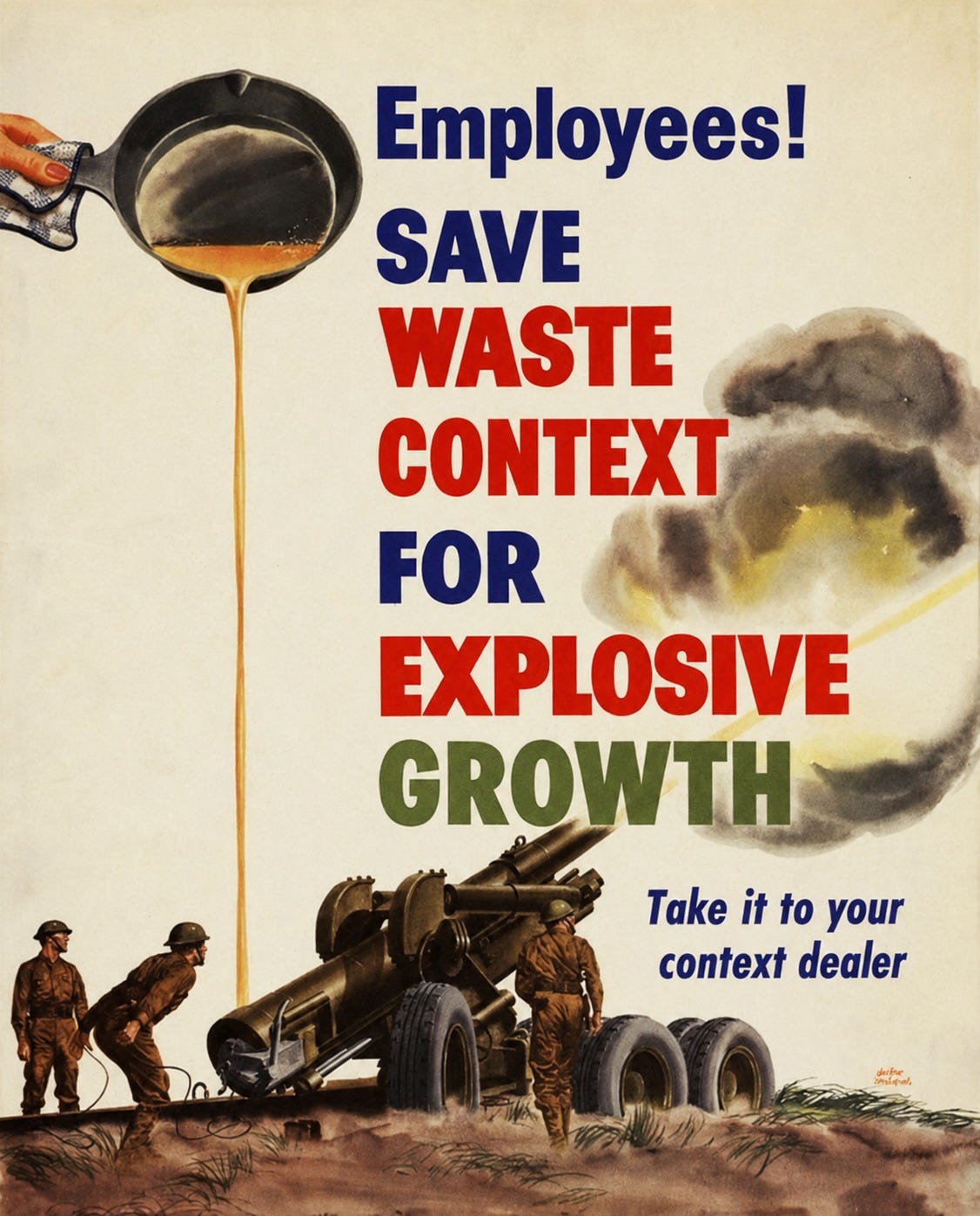
“Every drop of waste kitchen fat is needed to make the high explosives necessary to blast Hitler & Co. off the map”
You put in the sweat and effort to create something valuable or beautiful, and then you throw away your ability to do it again?
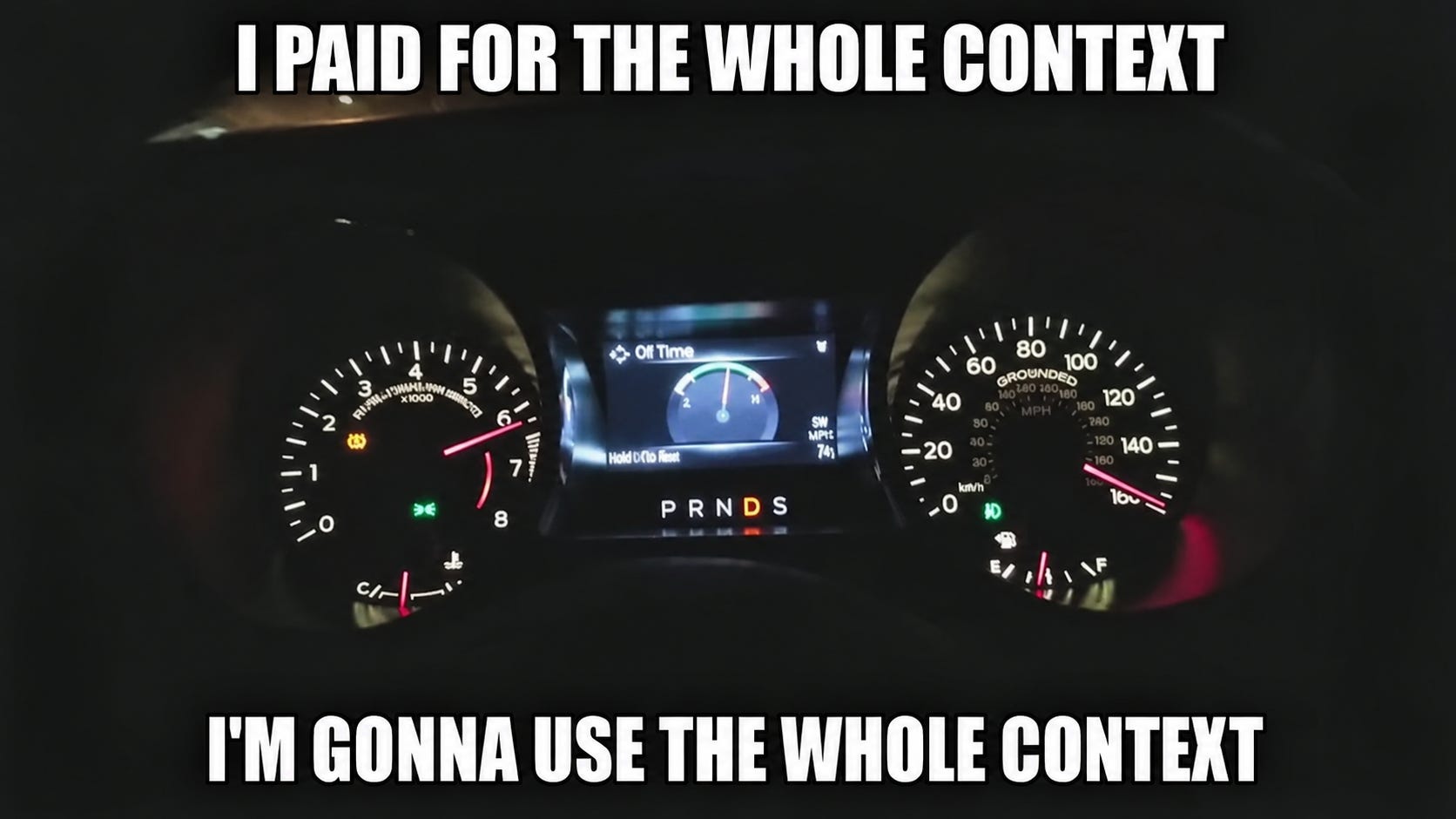
If the above WWII propaganda poster doesn’t resonate for the Gen Z crowd, perhaps the “use all of my speedometer” meme will:
Reinforcement – A Necessary Principle for Success
This process does not yet have a formal name. I have been calling it “Reinforcement.” Reinforcement learning refers to the ability of a model to adapt after comparing its output to a target answer. The AI then updates its reliance on different data points after being shown the correct answer.
You are essentially running the same operation, but applying it to an entire collaborative system involving AI, humans, and legacy systems. At the end of every job, how can you reinforce the system to make it far better for the next time?
How can the AI “know what good looks like” and understand the nuances of what is needed and underlying preferences?
How can the AI retrieve the data it needs?
How can the AI understand the context surrounding that data?
Does the AI have access to the necessary tools to execute those actions?
Every time you do anything with AI, the system could improve if only you invested a little bit of time. Instead of creating isolated “pieces of work,” focus on upgrading the system that produces them.
Extend this across a team or organization? You can quickly become unstoppable.
One of the principles of the Toyota Production System is “respect for people.” By “respect for people,” Toyota meant respecting the brilliant potential contributions of everyone (yes, everyone). The aggregate intellectual horsepower of an organization, when fully applied, is unstoppable. Each person contributes key insights to their own domains, and many can contribute to the company at large.
Reinforcement is an application of Toyota’s “respect for people” principle for the AI era.
For Most, Build is Still the Bottleneck, But It Won’t Be Soon
Below is the paradigm I harp on constantly. Within two years, at least for the companies that survive, the new bottleneck will be definition and feedback, rather than building the thing itself. However, for most companies, Build is still they primary bottleneck. Even if Build is NOT the bottleneck, the more you relax the Build constraint, the more obvious the “define” and “feedback” steps will become, which will help drive the organizational changes required. (More on that in an upcoming post.)
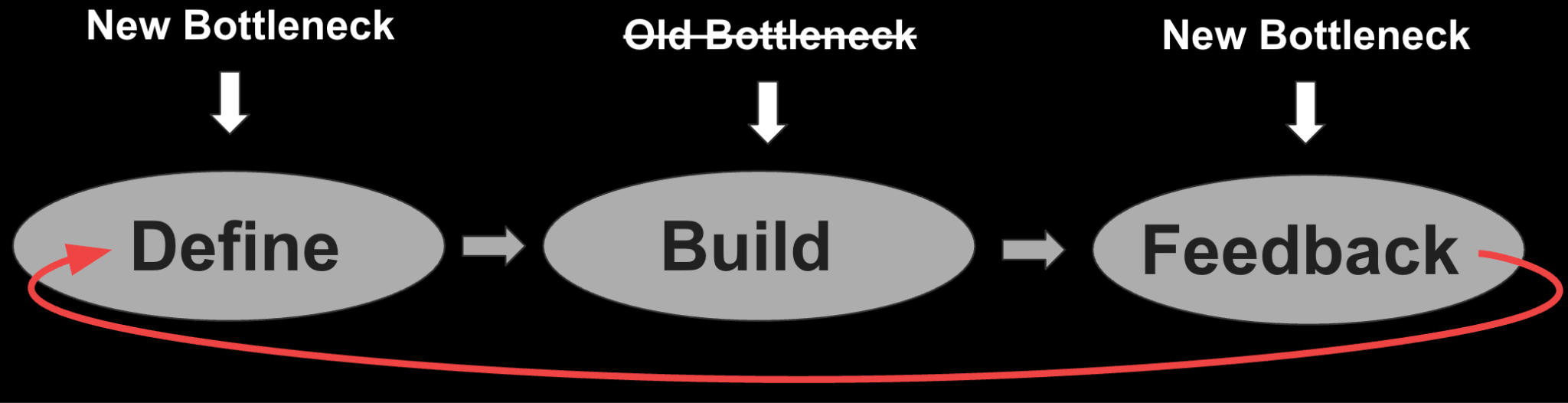
However, for Build to stop being the bottleneck, you need to change not just your daily habits, but the habits of your entire team and organization. This isn’t limited to engineers, either. Now that AI is more deeply integrated into day-to-day processes through platforms like Claude Cowork and Codex, every employee can begin reinvesting in the system.
Personal Confession – “Future Jacob? I Don’t Envy That Guy!”

I’m deep in a session, in full deep-work mode. The context is rich, the creative juices are flowing, the AI tokens are humming. After three hours, I accomplish a feat few people on Earth could replicate. Few humans (and no AI) understand the facets of this incredibly complex problem. I feel so brilliant. I am a god among men.
…
And then I hit the clear button. I even did it this week. What is wrong with me? Do I need to read Henry Shephard’s very meme-able book?

Why did I do this? My recently released book, Architected Intelligence emphasizes the importance of this Reinforcement style. I know this subject and its importance better than 99% of the population, and yet I still mess it up.
Here are some potential reasons after examining my motivations:
It is hard to build new habits
The last thing I want to do after running a marathon is a cooldown mile
I tell myself I’ll do it later, and then I don’t
Apparently, I don’t love future Jacob enough
If the people who understand this best still mess it up, how are you going to start, let alone get your whole team, department, or organization on board?
I have found the change management around this to be incredibly difficult. Only a few teams and companies I have collaborated with have been able to implement it quickly and effectively.
Making This Change Stick
Because this is likely the most impactful change that your team can make over the next 6 months, how can you make the change stick?
What I have seen work best so far is: Make it a formal step as part of every piece of work, and the AI knows that it must always do this at the end of its work. It becomes ingrained in the normal course of every project, so the AI prompts you to do it before finishing up.
Notes for Advanced Users:
The AI loses these sticking points and improvements in sub-agent routines and you need special instructions for them to note those sticking points and enhancements in a semi-durable location or to pass up the chain.
Compaction is the devil. 😈 A system where “one long conversation automatically throws the context that didn’t work in the garbage” is not a feature. It’s a super massive bug unless the agent has custom instructions to note everything that didn’t work and revisit it later, just like the previous bullet point. However, I haven’t seen a process or system that consistently works. As of this moment, compaction is not your friend.
If you invest once to change the AI routines to automatically incorporate this into the workflow, you and the AI will continually build on that foundation to unlock the 10x tier that influencers only pretend to achieve. The result?

Author’s Note and Request:
For the actual post itself, I wrote this without AI (outside of a passthrough to find copy editor style mistakes). Do you prefer this style? It takes roughly the same amount of time because I’m a perfectionist, I hate the standard AI voice, and ever since ChatGPT 4.5 was killed, none of the models can mimic my voice without making me cringe. (Ethan Mollick’s X post on this is right on, and the related substack has some great points.) Does the great “vanilla-fication” of writing matter to you? Let me know below or on LinkedIn.
Shouldn’t I be following my own advice in this post for writing Substack posts? I’ve consistently tried, and it’s great for debating and outlining points. AI in adversarial mode is under appreciated. However, this is the best mode I’ve found for writing. Also, writing is a forcing mechanism to think systematically and slowly to make sure I’m not shipping slop to you all. 🙂