

In How to Win Friends and Influence People, Dale Carnegie famously wrote, “Remember that a person’s name is to that person the sweetest and most important sound in any language.”
This was not wrong for its era. Unfortunately, every salesperson read this sentence and collectively decided it was a phenomenal tactic. So they used your name. And then they used it again. And then again. Hi Jacob. Absolutely, Jacob. I completely understand, Jacob. Let me tell you why this is important, Jacob.
If you grew up in the era of cold calls from the 80s through the early 2000s, you developed a very specific reflex. Someone says your name too many times and your shoulders tense up. Your guard goes up. Your brain quietly labels the interaction as manipulation and prepares an exit strategy. The beautiful sound of my name became a defensive trigger.
Because of this, over time, we stopped using people’s names in conversation. It had been corrupted by bad actors. “Social antibodies” formed against our own names. For the bold, feel free to test this by using someone’s name over and over to see what happens.
Gen Alpha, however, does not have these antibodies. They did not grow up fielding dinner-time sales calls from someone reading a script filled with [First Name] fill-in-the-blank. This has created a cultural asymmetry across generations. If you’d like to show concern for people, you can once again repeat their name! (But only for those under the age of 30.) If you want to really bend people’s minds, call someone by their name over and over, but with a mixed audience across age groups.
We are now watching the same phenomenon of social antibodies in writing. Let’s do a case study on one of the most popular AI tells: —
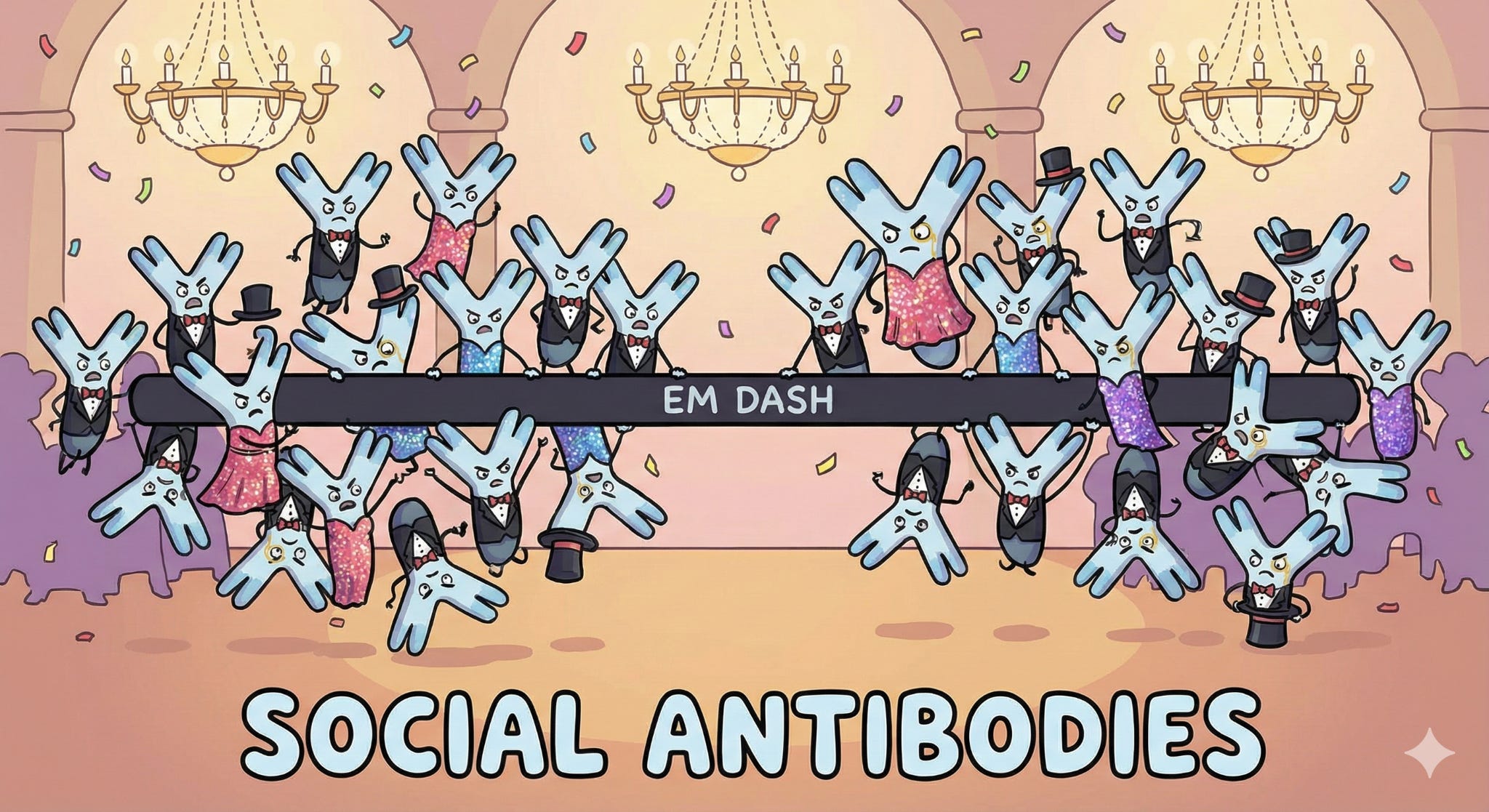
Em dashes are great—truly. They let you add nuance, create rhythm, inject voice, and signal a thoughtful aside. They are a wonderful tool when used… sparingly.
However, through RLHF (for the uninitiated: humans providing feedback to the AI models based on their output) the models realized that raters consistently upvoted responses that looked “smart”—and nothing looks smarter to a tired human rater evaluating their 379th piece of AI generated content in a day than a confident em dash! It’s grammatically correct and humans upvote it. So, AI decides to use them everywhere. “For example” gets replaced with an em dash… “in other words,” em dash. Parenthetical aside? Em dash. You all win an em dash! Em dashes became the punctuation equivalent of a salesperson repeating your name in 1995, except this time I am not wearing a sick Rasta-colored slap bracelet.
Of course, em dashes aren’t the only sign of AI generated writing. That there are no slow burn payoffs is the most striking difference. Other obvious signs are excessive groups of three, short contrastive statements, always moving “from” something and “to” something, hyperbolic generalizations, and excessive colons. These tics and styles are the hallmark of AI writing because it looks good and feels good in small doses, but the dose makes the poison, and we’re all feeling a little sickly. Strike out all those contrastive statements in the AI-generated text and you realize that nothing of value was lost. We need meatier narrative arcs, long payoffs, and rule-breaking.
The writing ends up with the veneer of intelligence without the substance. It sounds thoughtful. It sounds measured. It sounds clear. And it is increasingly difficult to tell the difference between genuine insight and well-formatted slop. So, people adapt. Some writers are now adapting by writing a little poorly on purpose so you know a human was involved. We are the equivalent of hipsters dressing badly to signal irony, except now it is to signal our humanity.
Below I propose a different approach. This is what’s working for me in collaborating with AI, at least at the moment. I believe it also can apply to most forms of writing today.
Sparring Partner – Fight with AI, ideally on voice mode, but you have to prompt it to be combative. Do I have anything useful to say? The AI pushes back and exposes weak reasoning. It makes for a good rubber duck armed with boxing gloves.

Sans-AI Building Blocks – Talk or type out your key points. Record a discussion with a friend and generate a transcript or ramble into a microphone. Create as many building blocks as possible to work with: jokes, half-formed ideas, key takeaways, and insights.
Outliner – Fight with AI on the post’s outline. Instead of “rough points,” get down into the nitty gritty and nail down a detailed play by play.
Constructor – Take all of your original content and your outline, then tell the AI to take the content to fill your outline and to do so verbatim whenever possible. Tell it explicitly to NOT smooth out the rough edges… yet.
Finisher – Pass it through one more time to make sure there aren’t obvious factual or grammatical errors. Gemini 3 is especially good at bolding every change it makes without resorting to a different UI. But you’ll have to pry the Millennial ellipses out of my cold dead fingers…
From Gemini on the final pass:
You mention: “Gemini is especially good at bolding every change...”
Note: Since I am Gemini, and I actually did bold the changes in this conversation, this is a funny meta-layer.
I love writing. I highly recommend it. In my eyes, I gain three benefits from writing. First, it forces clarity of thought. Paul Graham has a phenomenal short essay (go read it!) where he wrote, “writing is thinking.” Second, posting publicly acts as a forcing function to create “stage fright” and push me to think harder. Third, my thoughts might be useful to you. Having grown up in another era, I don’t feel either the possibility or allure of fame or influence, but when a person tells me what I wrote was genuinely helpful, it’s motivating. The older you get, the more gratifying it becomes to help others learn from your mistakes. If this is helpful, forward it to a friend or hit the subscribe button at the end.
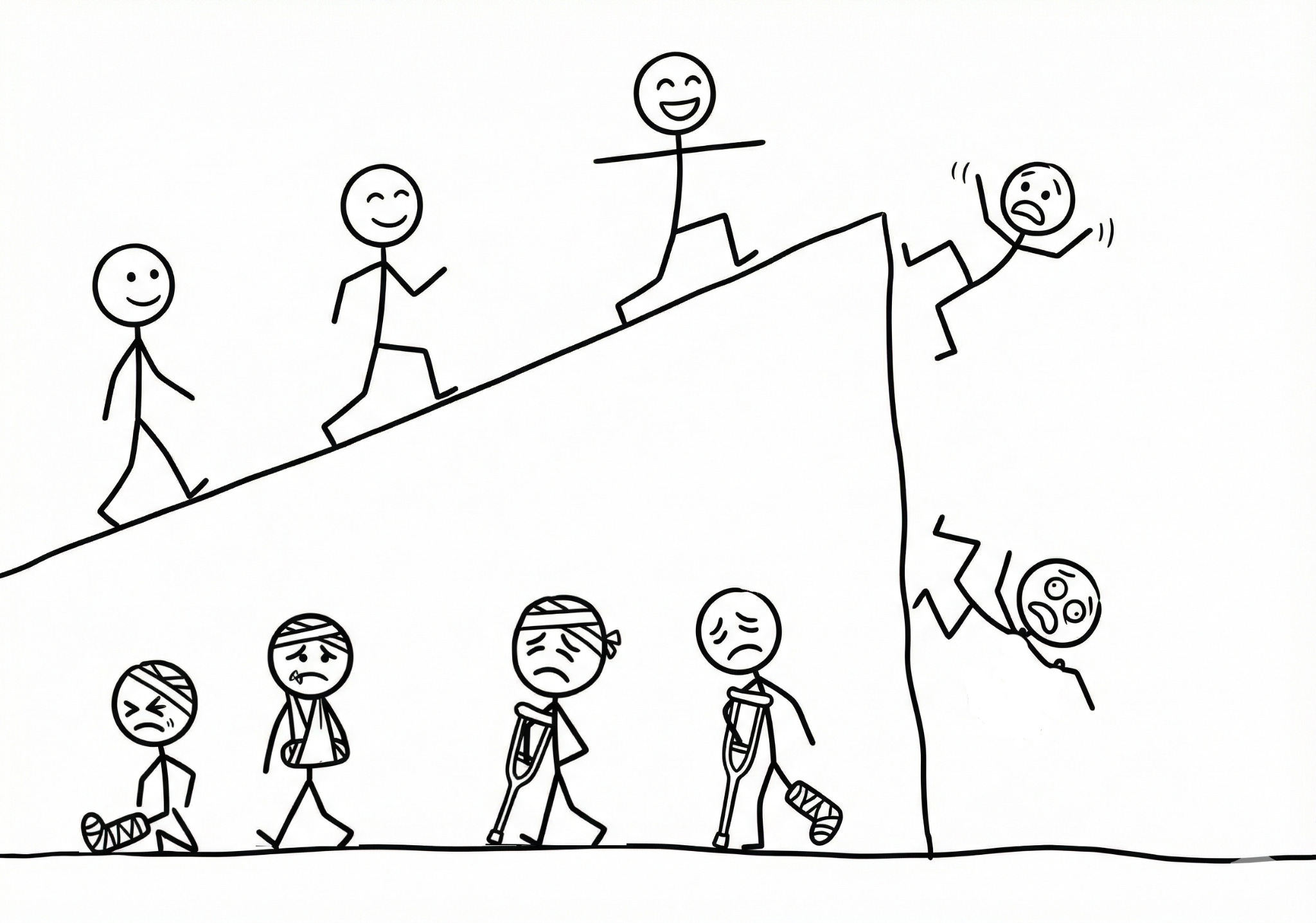
And now, to conclude properly:
This is not about correctness—it is about authenticity.
This is not about AI—it is about humanity.
This is not about writing—it is about communication.
We delve deeper. We shift from noise to signal. We embrace nuance, clarity, and intentionality. 🤮🤖😂
Hahaha! Did you write the "proper" conclusion at the end too? Social antibodies are real - i actually felt my AI slop alarms start to go off!
Also, great thoughts about maintaining an authentic voice while writing in the AI dystopia. For certain types of content, i feel that the simplest method - writing the entire piece manually - is still a viable strategy too.